


Every academic health system now has an AI story. Most of them are about tools: an ambient scribe here, an inbox assistant there, a pilot with a model vendor announced at a conference. Very few are about the thing underneath all of them, which is computing capacity, and who decides how it is bought, shared and paid for.
UT San Antonio has just put that question at the centre of its org chart. On 19 October its senior vice president and CIO, Michael Schnabel, announced on LinkedIn a “newly established leadership role”: a Senior Director of Research Computing, building one function across the university’s colleges and its health system.
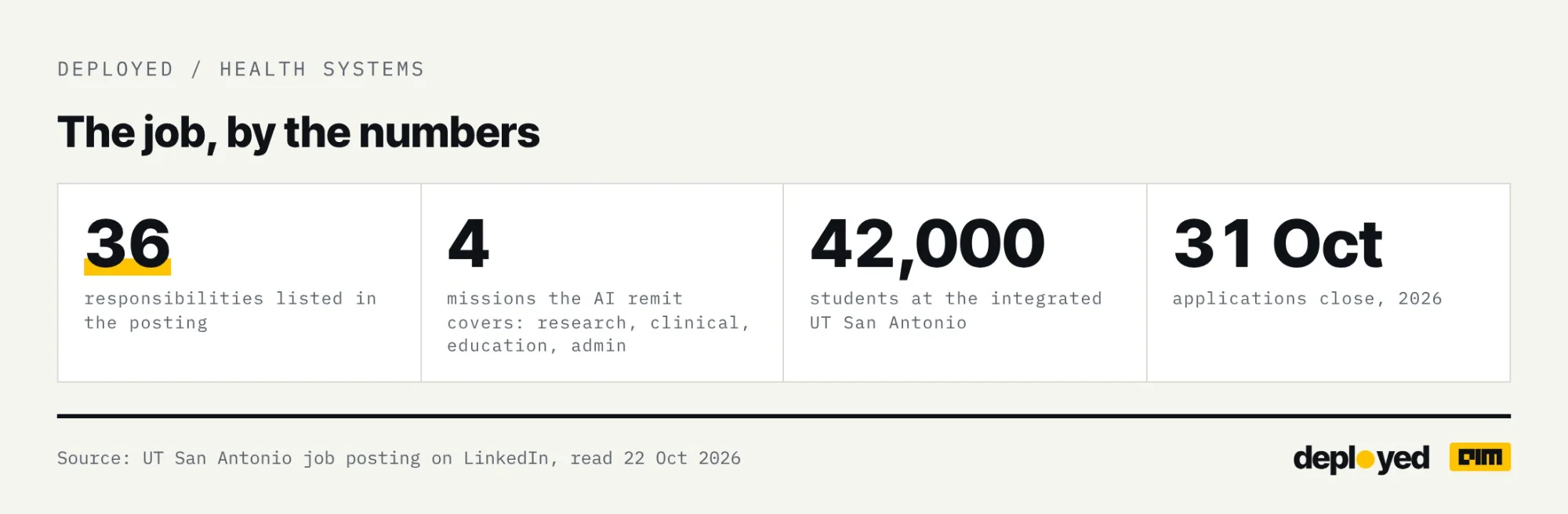
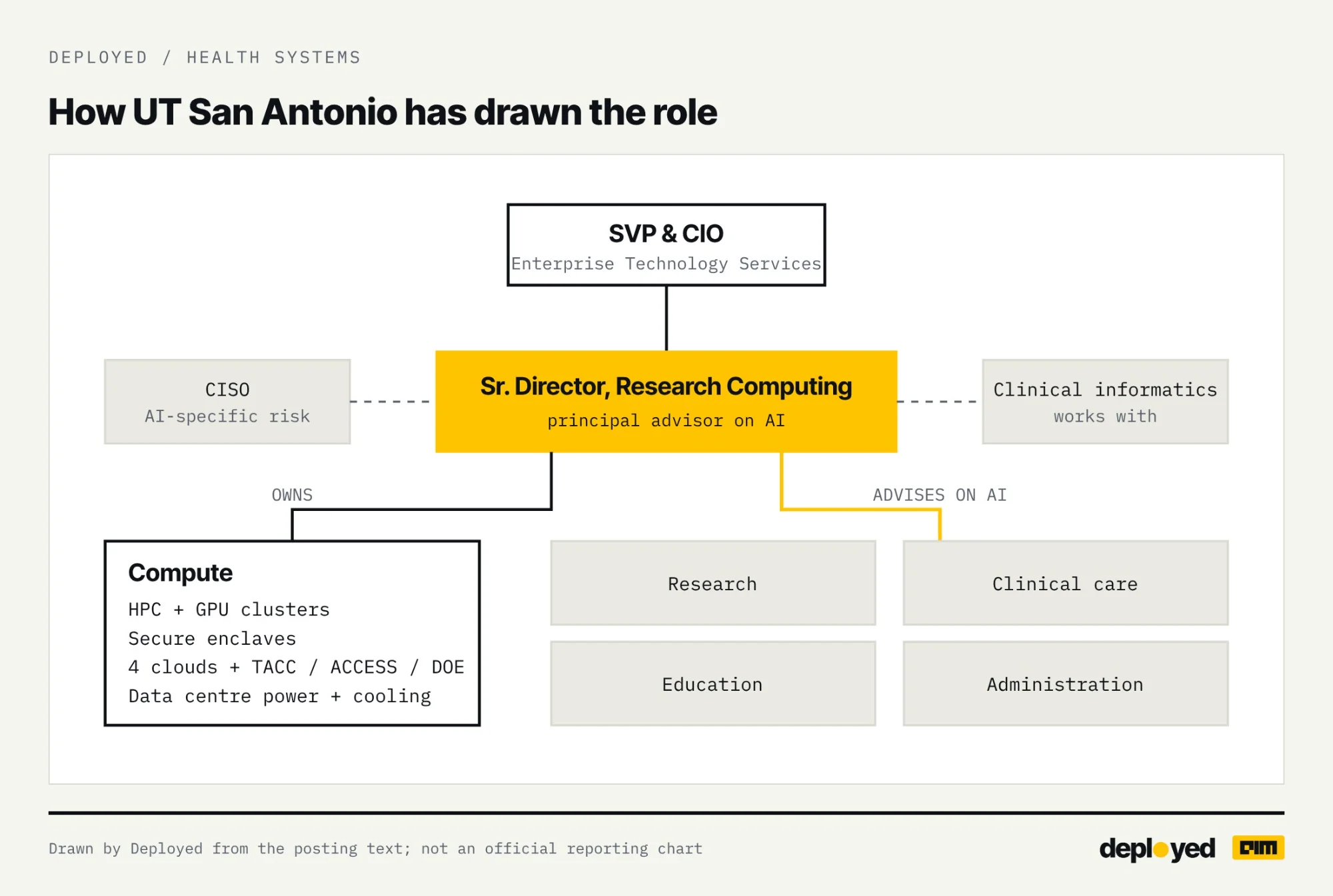
The title undersells it. The posting calls the role the institution’s “principal advisor on artificial intelligence”, responsible for enterprise AI strategy, governance and adoption “across research, clinical, educational, and administrative functions.” The same person will run high-performance computing, GPU clusters, secure enclaves for regulated data, cloud landing zones on AWS, Azure, Google Cloud and Oracle, and the link to the Texas Advanced Computing Center.
The person who owns the GPUs will also own the AI strategy. That is the right call, and much of academic medicine has it the other way round.
Why compute, and not an AI office
A common pattern in health systems has been to appoint an AI leader whose remit is use cases and governance committees, set apart from the people who run the infrastructure. That produces an office that can approve a tool but cannot say what it will cost at scale, where the data will run, or whether the cluster has room for the next grant.
Schnabel has been blunt about the cost side. In a LinkedIn post last month on “tokenomics” in Epic’s AI pricing, he warned that health systems are moving from predictable licence fees to consumption-based costs, and that a cheap-looking AI feature “can create a budget problem several years down the road.” His prescription was dashboards and thresholds: what are we spending, where, and what are we getting back.

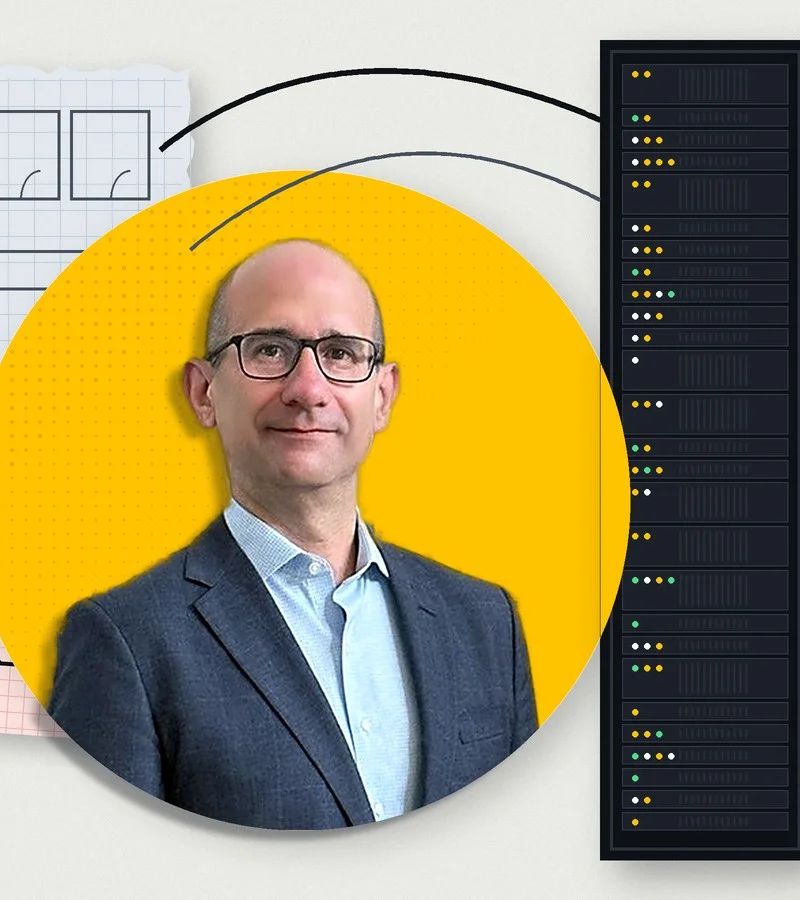
Michael Schnabel, Senior Vice President and Chief Information Officer, UT San Antonio. Photo: UT Health San Antonio
“The technology is moving faster than our traditional budgeting and governance models.” Michael Schnabel, on LinkedIn, September 2026
You cannot answer those questions from a committee room. You answer them where the workloads run. Putting AI strategy inside research computing ties the policy to the meter.
The case against
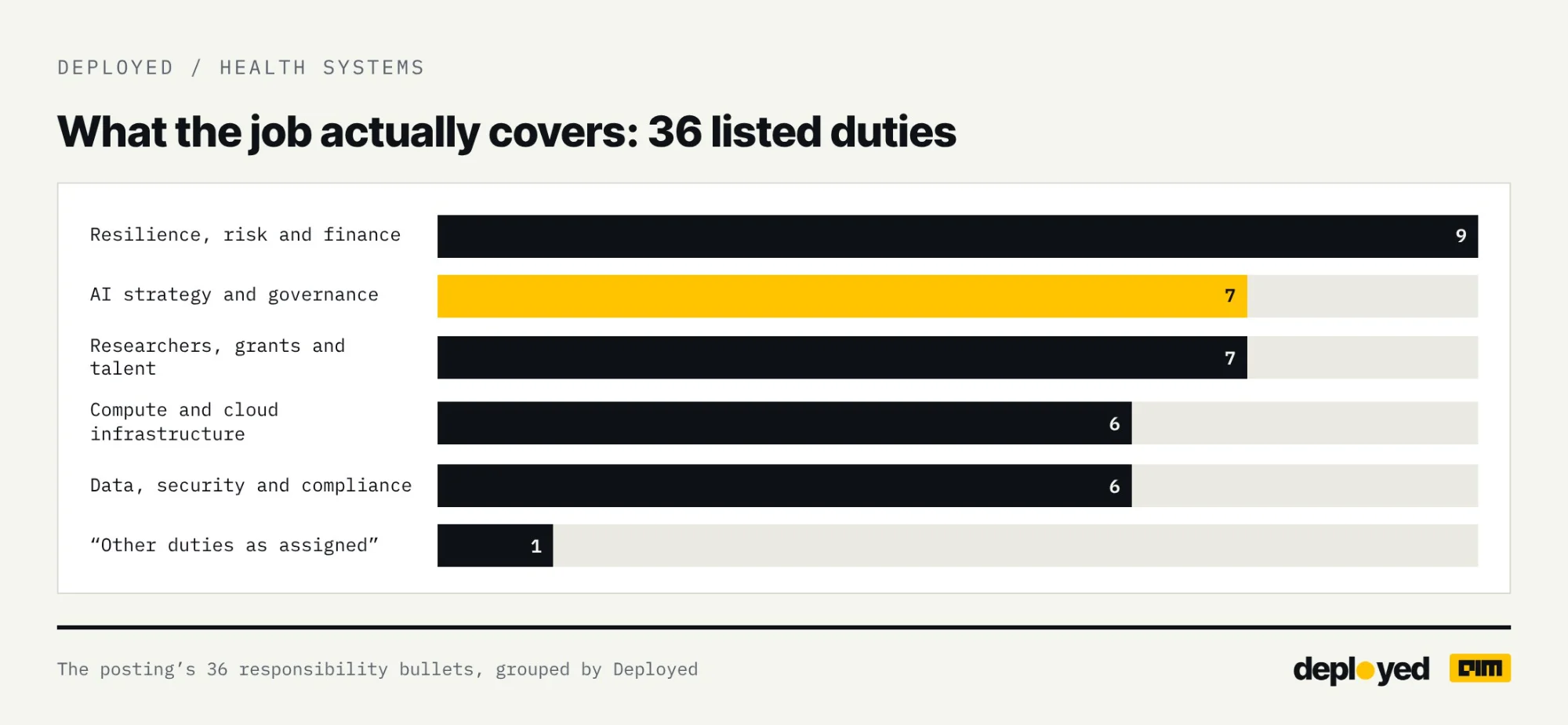
Here the move gets uncomfortable. AI strategy and governance make up about a fifth of a list that runs from NIH S10 grant support to recovery drills to enclaves for classified research. Clinicians who have watched IT departments slow-walk new tools will ask why decisions about AI at the bedside should sit with a research-infrastructure leader inside Enterprise Technology Services, and not with a chief medical information officer or a physician AI lead.
They have a point. The posting says the role works with “clinical informatics leaders”, but it is a senior director, not a C-suite seat. If an ambient documentation rollout and a cardiology lab want the same GPUs, who wins? Can one person credibly speak for biomedical investigators, defence researchers and hospital operations at once?
The opposite failure is also possible. A leader rewarded for faculty satisfaction and grant wins may treat clinical AI as one more tenant, and underweight the patient-safety evaluation that bedside tools need.
Everyone is hiring for this layer
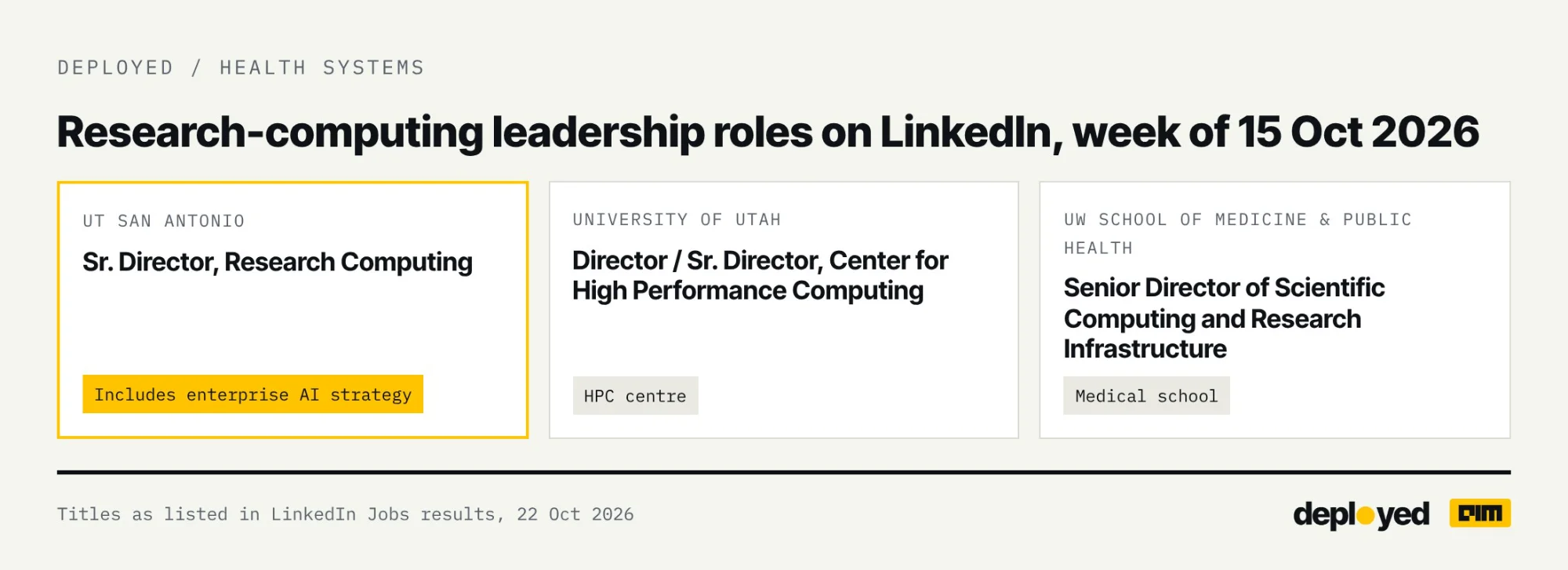
San Antonio is not alone in building the compute layer. The same LinkedIn search that surfaced its posting returned two peers posted within the same week, at the University of Utah and the UW School of Medicine and Public Health. What sets the San Antonio role apart is the decision to hang enterprise AI strategy on it.
The argument
The institutions that get AI right over the next five years will treat it as an operational resource with a cost, a capacity limit and an owner, not as a portfolio of pilots. The person accountable for AI strategy should be the person who has to find the power, the cooling, the GPUs and the budget when an idea works. UT San Antonio has written that into a job description. Others should follow, or explain how their AI officer does the job without the keys to the machines.
Three questions for Michael Schnabel
- When clinical AI and a funded research project want the same GPUs, who breaks the tie?
- Does the new role decide on clinical AI tools, or only advise on them?
- Will AI consumption be charged back to departments, as your tokenomics post suggests it should be tracked?
Deployed has not yet spoken to UT San Antonio. Quotes are from Schnabel’s public LinkedIn posts and the university’s job posting.